Publications and communications
This is the list of my most recent publications and communications. Do not hesitate to contact me (here) if you wish to have a pre-print version or for any questions and/or comments.
Peer-reviewed articles
Havet, H. (2023). The underlying structure(s) of Japanese numerals: the case of kyuu ‘9’ and zyuu ‘10’. Phonological Studies, 26 , 3–10. ISBN: 978-4-7589-2026-1.
Numerical complex words in Japanese, such as ik-kai ‘1 time’, huta-ri ‘2 people’, or san-ton ‘3 tons’, exhibit numerous morphophonological alternations (e.g., gemination, voicing, epenthesis, etc.). Although these alternations have been fairly well studied in general Japanese phonology, little work has focused specifically on these phenomena when they occur in numeral complex words. In this article, we examine the numerals kyuu ‘9’ and zyuu ‘10’. The surface form of both numerals has a long vowel. However, they behave differently. Kyuu ‘9’ sometimes has a form without the palatal element ku ‘9’, as in ku-zi ‘9 o’clock’. The numeral zyuu ‘10’ is often assimilated. When assimilated, the initial consonant of the classifier is geminated, and the vowel optionally changes from /u/ to /i/, as in zyuk-kai ~ zik-kai ‘10 times’. Previous studies have attempted to explain the ku ~ kyuu ‘9’ alternation using various rules (e.g., glide formation, vowel lengthening, etc.), as in Lawrence (2004). To explain the zyuu ~ zyuQ ~ ziQ ‘10’ alternations, two underlying structures have been proposed, as in McCawley (1968). Using an original database containing over 3,000 complex numeral words, this paper attempts to demonstrate that kyuu ‘9’, ku ‘9’, and zyuu ‘10’ are three distinct underlying structures. Click here to access
Labrune, L, Havet, H. (2023). Japanese numeral complex words with a native classifier: phonological insights. Phonological Studies, 26 , 31–42. ISBN: 978-4-7589-2026-1.
In this article, we compare 23 native nouns that can be used both on their own and as classifiers. We compare their behavior when they appear in complex numeral words and complex determinative words. Our results indicate that the behavior of these nouns differs with respect to gemination, rendaku, p-ization, and stress. In particular, we note that complex numeral words receive penultimate stress or are unstressed when they have an adverbial value. We propose that these complex words have post-lexical stress regardless of their phonological properties. Furthermore, we hypothesize that these complex words are composed of two affixes, without a root. Click here to access
Chapters
Havet, H. (2025). Le numéral ‘4’ en japonais : processus et motivations des variations de prononciations. In S. Couralet, L. Labrune & C. Shirota (Eds), Linguistique coréenne et japonaise: dynamiques contrastives, 284–298. Pessac : Presses Universitaires de Bordeaux. ISBN13: 979-1030011692
First, we propose to trace the evolution of the pronunciations of 四 ‘4’ in Japanese. It is often said that the avoidance of the Sino-Japanese pronunciation shi ‘4’ is due to its homophony with shi ‘dead’. However, sources seem to indicate that this pronunciation continued to be used at least until the beginning of the 20th century. We show that the native pronunciation yo ‘4’ was used as a variant of shi from the 8th century onwards, before the development of a new variant, yon, towards the end of the 19th century. Yon first entered colloquial speech before becoming established in military and technological circles, presumably for reasons of intelligibility. Second, we study the distribution of the various pronunciations of '4' in modern Japanese. It would appear that today, the pronunciation shi is practically no longer used. Yon, although of more recent formation, seems to have acquired the status of the default pronunciation and is now by far the most common in dictionary recommendations. Yo appears today essentially as a variant of yon. Finally, in a third step, we will examine the morphological origin of yon. Yon is generally considered a neologism constructed from yo ‘4’ and san ‘3’. We intend to show that it could also be a case of prosodic augmentation, a common phenomenon in adverbs, for example, and one that is found more marginally with other numerals. Click here to buy
Other articles
Havet, H. (2024). Le jeu du shifumi : analyse d’un emprunt linguistique du japonais au français, 37–45. Etudes françaises, 33.
In this article, I propose to trace the case of a linguistic borrowing: that of the Japanese word “shifumi”. While mainstream sources explain that shifumi is an acronym formed by apocope from hito-tsu ‘1’, futa-tsu ‘2’, mit-tsu ‘3’, I suggest a new, more likely explanation. The word, in my view, derives from the first three numerals of the native enumeration list: hii..fuu..mii ‘1.. 2.. 3..’, which is particularly common in children's literature. The pronunciation shi in its French adaptation, in our opinion, suggests a Tokyo origin, linked to the dialect of the capital's merchants. It is therefore possible that this song was heard during games of temari (ball game) on the outskirts of the capital, or in certain variants of janken (Japanese name for the rock-paper-scissors game), which contains, for its introductory formula saisho wa guu, janken pon!, many variants. Click here to read!
Communications
Havet, H. (2025, August 13). Adopting a usage-based approach to describe alternations and instances of variation occurring in Japanese numeral complex words. Usage-based approaches to phonology, University of Oregon, Eugene, OR.
In this presentation, I propose an approach based on the use of voicing and the h~p alternation occurring after san '3' and yon '4' in complex numeral words in Japanese. These two phenomena exhibit significant variability. While studies to date have attempted to account for these alternations systematically, focusing primarily on the underlying structure, I propose an opposing approach by considering the following parameters: frequency and diachronic evolution. These elements allow me, based on dictionary data, to show that while voicing appears unproductive and increasingly limited to a few very frequent occurrences, the h~p alternation is productive and persists. Furthermore, we show that in some cases, the realization of p after yon '4' is analogous to that of san '3'. Finally, I conclude by proposing a model of entropy to try to predict the realization of the h~p alternation. Click here to read the abstract
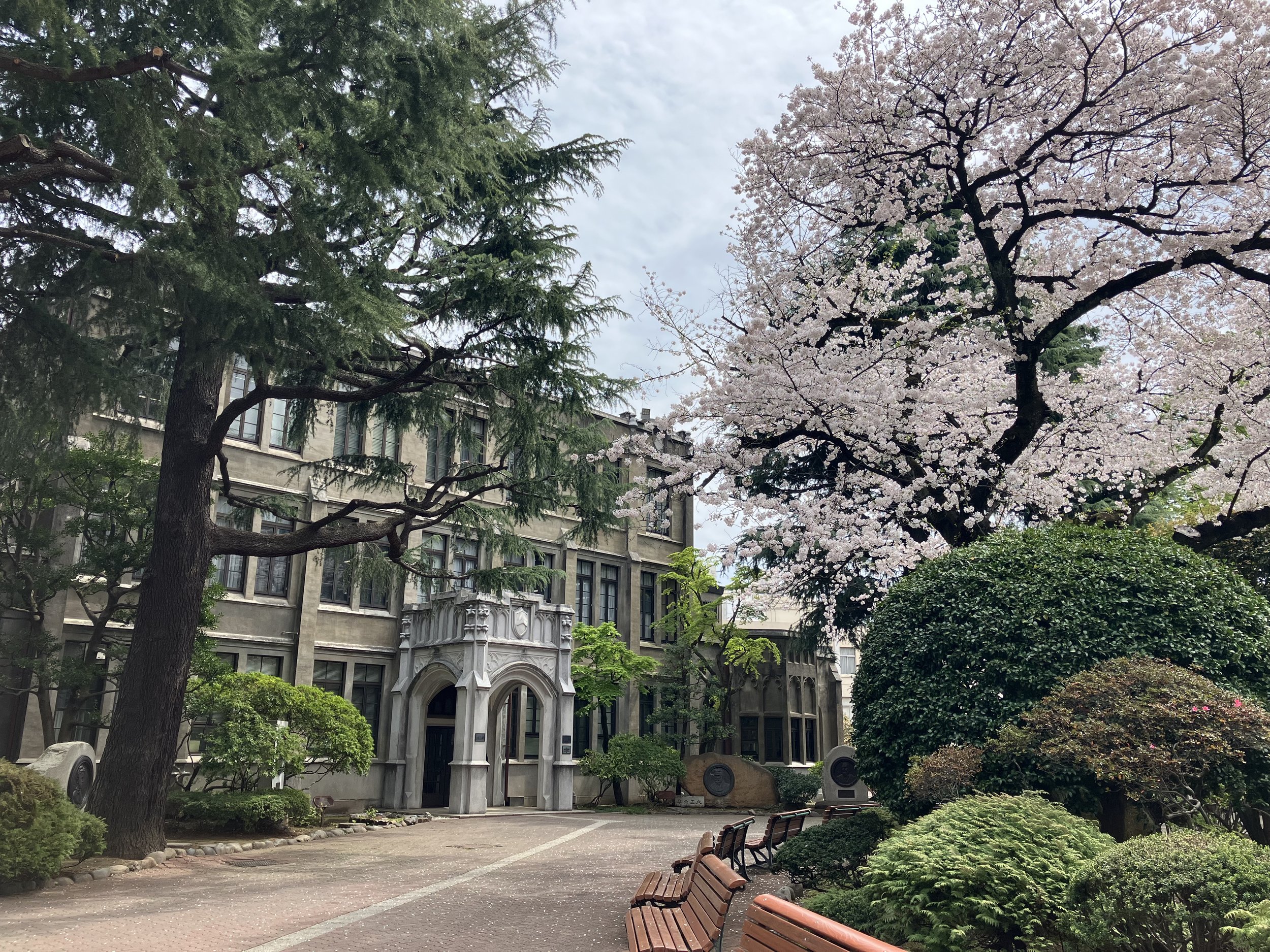
Image: Sakura trees in Aoyama Gakuin University, Aoyama Campus. 04.2024. Credits: Helline Havet
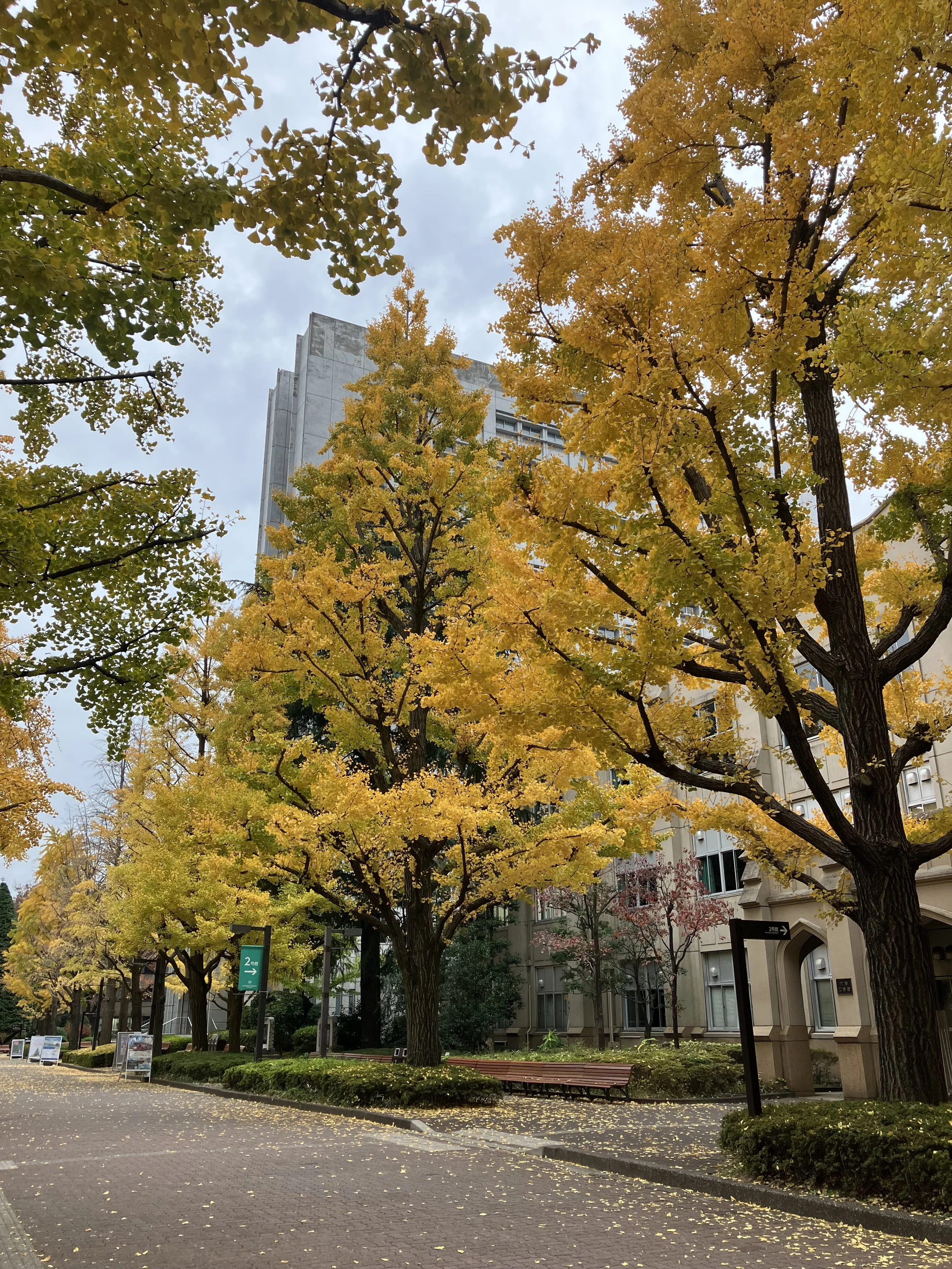
Image: Autumn leaves in Aoyama Gakuin University, Aoyama Campus. 11.2025. Credits: Helline Havet